

Reclaiming Hope - University of Bristol Botanic Gardens & Co2re the UK greenhouse gas removal hub
Billie Ireland’s Sacred Carbon
Reclaiming Hope - University of Bristol Botanic Gardens & Co2re the UK greenhouse gas removal hub
Billie Ireland’s Sacred Carbon
Reclaiming Hope, Removing Carbon
Co2re Oxford University
Billie Ireland’s Sacred Carbon: Where the past, present and future merge, was exhibited as part of Reclaiming Hope, Removing Carbon at the Bristol Botanic Gardens in June 2026.
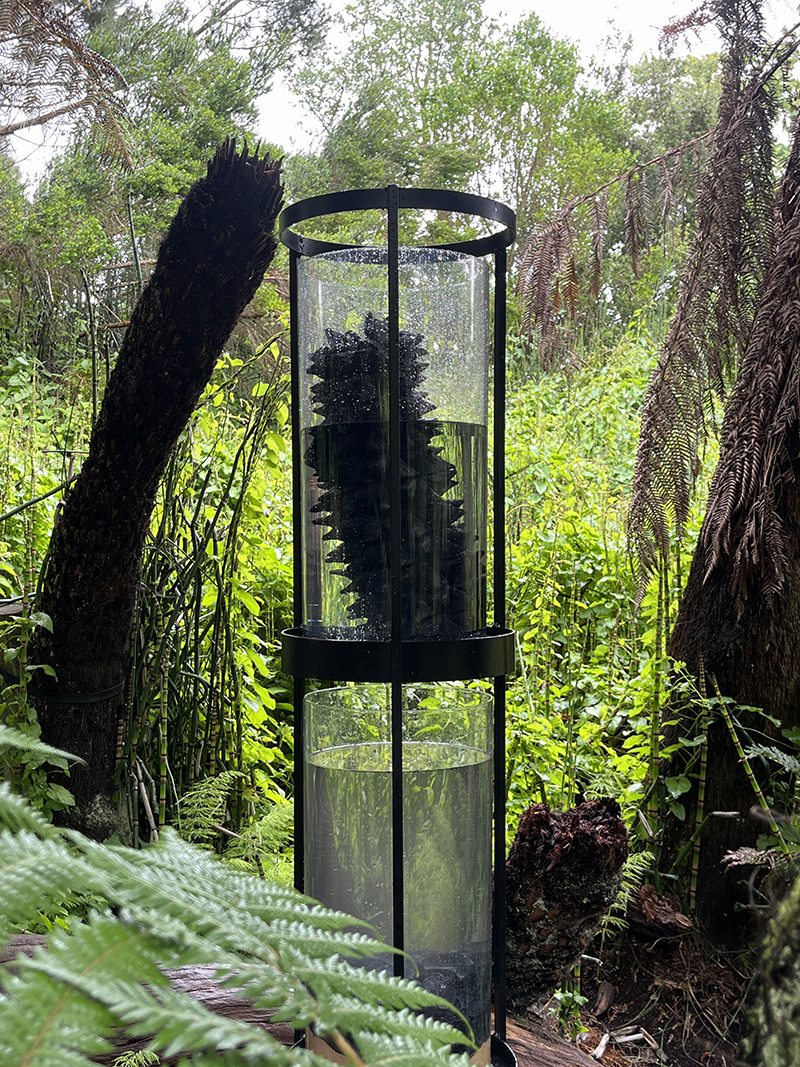
In the Carboniferous area of the garden, a series of sculptural works were suspended in clear vessels. While in another area of the garden a series of sculptures were immersed in the pond.
Their forms draw inspiration from ancient plant life and sacred geometry, referencing deep time and the origins of the carbon now stored within the Earth.
The delicate works were left exposed to the elements for the duration of the exhibition. This contrast of permanence and fragility reflects the unstable balance of carbon in our environment.
These sculptures are made from biochar, a carbon-rich material created through the heating of organic matter in low oxygen conditions. Stable yet fragile, biochar is increasingly explored as a method for long-term carbon storage. Drawing on ideas of purification ritual and reverence, the work creates space to reflect on the materials and processes that sustain life.
Being commissioned to create biochar sculptures for the lush Carboniferous area of the University of Bristol Botanic Gardens sparked a creative dilemma: how could theses static artworks resonate within such a vibrant, prehistoric landscape? Grounded in scientific and material research, the project evolved into an exploration of the Carboniferous, ancient horsetails, silica, and water remediation.
I was asked to put some of my biochar sculptures into the Carboniferous area of the University of Bristol Botanic Gardens. As much as I was delighted about that, I was also struck by the fact that this was such a beautiful, fecund, and lush area with tree ferns, all this growth, and beauty. This is a place where you are magically transported into another time and space. How would my work help that, resonate with it, or bring anything valuable to the space?
I found that to be a bit of a dilemma, so I went back to the science and the research. I began tinkering with the science of carbon and the Carboniferous period, the materials, and what might tie it all together. Initially, while reading about the Carboniferous and visiting museum displays and specimens, I was drawn to the horsetail. I had already played with this material because we have a lot of it in our local canals, and it had been on my list of invasive species; even though it is technically a native.
Another amazing fact I found out was that it is 25% silica, and it is stunning. When the light comes through the horsetail, it looks like glass; you can understand that it is structurally made of silica. It is a beautiful, glowing, life-affirming green. It grows in segments and repetition, like many plants in the Carboniferous. Propagating via seeds and spores with no flowering plants, they were structurally huge in the Carboniferous period; reaching 30 metres tall and a metre in diameter, yet remaining hollow.
So, I went down the route of sand, glass, and silica. We process bio-silica from the horsetail, which is a wonderful element. There is a deep connection with the Carboniferous period and the laying down of what would become fossil fuels a melting pot of fire, water, and too much oxygen creating a smoky yellow atmosphere. During that elemental time, the laying down of those fossil fuels occurred, which we now know are causing us huge problems with CO2. My work with biochar acts as a carbon sink, doing the exact opposite. Its potential to store carbon, lay it back down into the earth, purify, regenerate, or act as a remedial tool is really fascinating.
This led me down a route of my own, which is perhaps the more spiritual, heart-led, or emotive side of life and death, and how this material might make us feel. This pairs with the science side of it, where it can be used to purify water, remediate polluted lands, and draw out heavy metals to sort out some of the problems we have created.
I created these vessels that would hopefully make people think, "Hang on, what is that amongst this lush undergrowth? Is it doing something? What are these strange objects floating in this liquid inside the vessel?" They were a token nod toward the idea of a filtering system. My biochar sculptures represent death, or the holding and distilling down of life. The next chamber filters and purifies water taken from the River Severn, which flows from its source where I live in Wales to the sea in Bristol. Then there is a layer of renewal, filtering out our impurities and I do not need to say much about the state of our rivers for this to make sense. Finally, water that has potentially been purified becomes sacred again in the third and final chamber at ground level. That was the thinking behind the installations commissioned for the Carboniferous area.
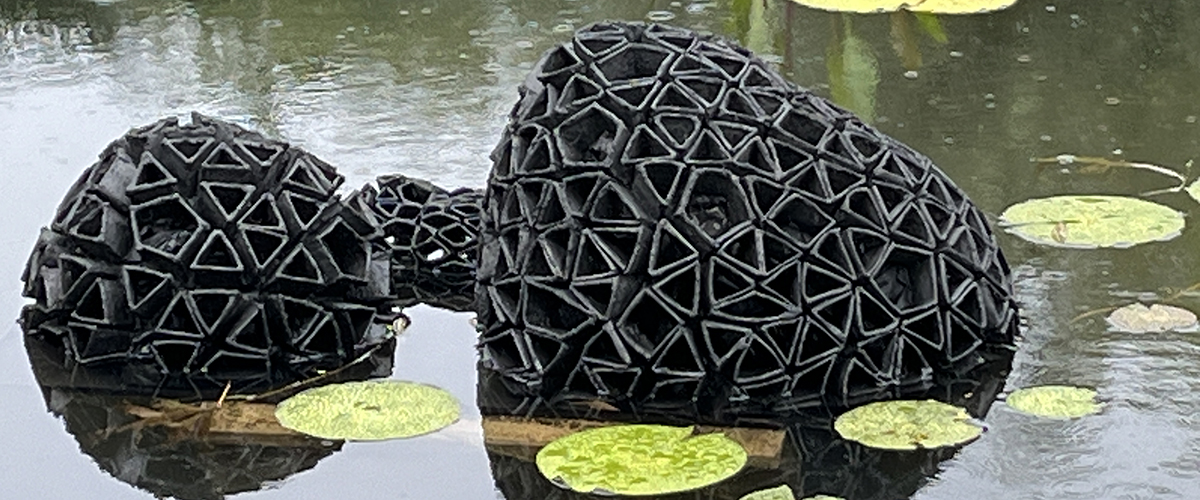
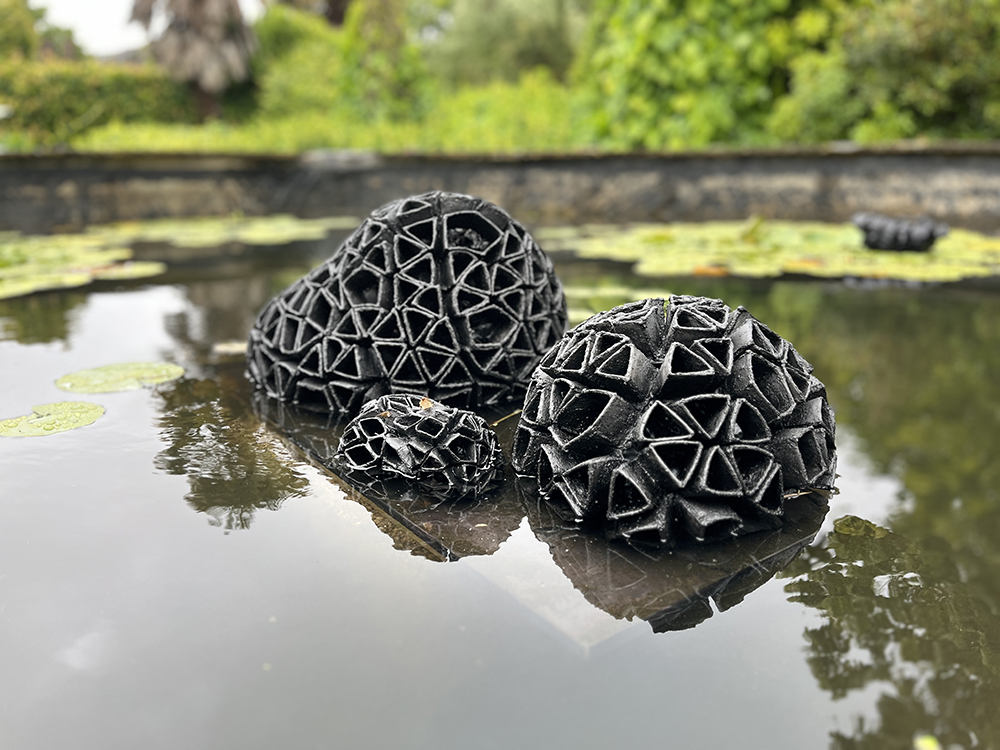
Alongside these works, I made some complex and structurally challenging pieces for the raised pond. Ultimately, this commission and the CO2RE creative projects were meant to be experimental and focused on material research. It was about researching this material, its structure, and its potential. I like to work in threes, so I made three purification stands and three sculptures; a little grouping that sat in the pond, slightly submerged in the water. Again, this was a play between the sacred, spiritual, and emotive side of the work and the science, questioning what function this material might have for the pond itself, for the "more-than-human," and its relationship to everything in the space.
They were designed as an experiment. Halfway through the weekend, people panicked because one form had collapsed into the water. But that was actually the intention. These are very fragile forms, and the whole point of biochar in science is that it is super porous with a huge surface area. The higher the temperature you cook it at, the more porous it becomes, increasing its ability to store water and nutrients, or even potentially suck out pollutants like heavy metals.
So, they sat in the water, slowly drawing in liquid from the pond over time. Then the weather changed, which says a lot about our environment and climate. It went from two days of cold, wet, windy, and damp weather to being incredibly hot over the weekend. Because of this, the works acted like thermal sinks. They are dark and porous, so they became superheated at the top while drawing up cold water from underneath. Of course, this temperature differential causes a fracture, so I was actually surprised the large piece didn't collapse right away (though it has since).
What was intended was for the collapsed biochar material to enter the pond. If there are too many nutrients causing algal blooms and imbalances, it can potentially draw out and store those nutrients. Biochar is used for big bodies of water by creating biochar booms that capture dangerous algal blooms, catching the nutrients or pollutants and helping the pond and its tiny ecosystem, which is connected to the rest of the garden.
It was fabulous to take some of my previous works and research; where the biochar had been stored in water for several years and expand on this idea.
Being embedded in the world of climate science with co2re greenhouse gas removal hub for the past 18 months has led to some really interesting developments in my work and practice for which I am truly grateful.
Images: Photos by Hanieh Shabahang & Billie Ireland
Co2re Oxford University
Billie Ireland’s Sacred Carbon: Where the past, present and future merge, was exhibited as part of Reclaiming Hope, Removing Carbon at the Bristol Botanic Gardens in June 2026.
In the Carboniferous area of the garden, a series of sculptural works were suspended in clear vessels. While in another area of the garden a series of sculptures were immersed in the pond.
Their forms draw inspiration from ancient plant life and sacred geometry, referencing deep time and the origins of the carbon now stored within the Earth.
The delicate works were left exposed to the elements for the duration of the exhibition. This contrast of permanence and fragility reflects the unstable balance of carbon in our environment.
These sculptures are made from biochar, a carbon-rich material created through the heating of organic matter in low oxygen conditions. Stable yet fragile, biochar is increasingly explored as a method for long-term carbon storage. Drawing on ideas of purification ritual and reverence, the work creates space to reflect on the materials and processes that sustain life.
Being commissioned to create biochar sculptures for the lush Carboniferous area of the University of Bristol Botanic Gardens sparked a creative dilemma: how could theses static artworks resonate within such a vibrant, prehistoric landscape? Grounded in scientific and material research, the project evolved into an exploration of the Carboniferous, ancient horsetails, silica, and water remediation.
I was asked to put some of my biochar sculptures into the Carboniferous area of the University of Bristol Botanic Gardens. As much as I was delighted about that, I was also struck by the fact that this was such a beautiful, fecund, and lush area with tree ferns, all this growth, and beauty. This is a place where you are magically transported into another time and space. How would my work help that, resonate with it, or bring anything valuable to the space?
I found that to be a bit of a dilemma, so I went back to the science and the research. I began tinkering with the science of carbon and the Carboniferous period, the materials, and what might tie it all together. Initially, while reading about the Carboniferous and visiting museum displays and specimens, I was drawn to the horsetail. I had already played with this material because we have a lot of it in our local canals, and it had been on my list of invasive species; even though it is technically a native.
Another amazing fact I found out was that it is 25% silica, and it is stunning. When the light comes through the horsetail, it looks like glass; you can understand that it is structurally made of silica. It is a beautiful, glowing, life-affirming green. It grows in segments and repetition, like many plants in the Carboniferous. Propagating via seeds and spores with no flowering plants, they were structurally huge in the Carboniferous period; reaching 30 metres tall and a metre in diameter, yet remaining hollow.
So, I went down the route of sand, glass, and silica. We process bio-silica from the horsetail, which is a wonderful element. There is a deep connection with the Carboniferous period and the laying down of what would become fossil fuels a melting pot of fire, water, and too much oxygen creating a smoky yellow atmosphere. During that elemental time, the laying down of those fossil fuels occurred, which we now know are causing us huge problems with CO2. My work with biochar acts as a carbon sink, doing the exact opposite. Its potential to store carbon, lay it back down into the earth, purify, regenerate, or act as a remedial tool is really fascinating.
This led me down a route of my own, which is perhaps the more spiritual, heart-led, or emotive side of life and death, and how this material might make us feel. This pairs with the science side of it, where it can be used to purify water, remediate polluted lands, and draw out heavy metals to sort out some of the problems we have created.
I created these vessels that would hopefully make people think, "Hang on, what is that amongst this lush undergrowth? Is it doing something? What are these strange objects floating in this liquid inside the vessel?" They were a token nod toward the idea of a filtering system. My biochar sculptures represent death, or the holding and distilling down of life. The next chamber filters and purifies water taken from the River Severn, which flows from its source where I live in Wales to the sea in Bristol. Then there is a layer of renewal, filtering out our impurities and I do not need to say much about the state of our rivers for this to make sense. Finally, water that has potentially been purified becomes sacred again in the third and final chamber at ground level. That was the thinking behind the installations commissioned for the Carboniferous area.
Alongside these works, I made some complex and structurally challenging pieces for the raised pond. Ultimately, this commission and the CO2RE creative projects were meant to be experimental and focused on material research. It was about researching this material, its structure, and its potential. I like to work in threes, so I made three purification stands and three sculptures; a little grouping that sat in the pond, slightly submerged in the water. Again, this was a play between the sacred, spiritual, and emotive side of the work and the science, questioning what function this material might have for the pond itself, for the "more-than-human," and its relationship to everything in the space.
They were designed as an experiment. Halfway through the weekend, people panicked because one form had collapsed into the water. But that was actually the intention. These are very fragile forms, and the whole point of biochar in science is that it is super porous with a huge surface area. The higher the temperature you cook it at, the more porous it becomes, increasing its ability to store water and nutrients, or even potentially suck out pollutants like heavy metals.
So, they sat in the water, slowly drawing in liquid from the pond over time. Then the weather changed, which says a lot about our environment and climate. It went from two days of cold, wet, windy, and damp weather to being incredibly hot over the weekend. Because of this, the works acted like thermal sinks. They are dark and porous, so they became superheated at the top while drawing up cold water from underneath. Of course, this temperature differential causes a fracture, so I was actually surprised the large piece didn't collapse right away (though it has since).
What was intended was for the collapsed biochar material to enter the pond. If there are too many nutrients causing algal blooms and imbalances, it can potentially draw out and store those nutrients. Biochar is used for big bodies of water by creating biochar booms that capture dangerous algal blooms, catching the nutrients or pollutants and helping the pond and its tiny ecosystem, which is connected to the rest of the garden.
It was fabulous to take some of my previous works and research; where the biochar had been stored in water for several years and expand on this idea.
Being embedded in the world of climate science with co2re greenhouse gas removal hub for the past 18 months has led to some really interesting developments in my work and practice for which I am truly grateful.
Images: Photos by Hanieh Shabahang & Billie Ireland
